Host & Gather Sale | up to 50% off

Registry Durability Guide
for Your Wedding List
Porcelain vs. Stoneware vs. Bone China
When you’re building a wedding registry, durability is usually the first practical question that comes up. You’re not just picking dinnerware you love today; you’re choosing pieces meant to survive years of weeknight dinners, dishwasher cycles, holiday hosting, and the occasional slip out of soapy hands.
So how do porcelain, stoneware, and bone china compare when it comes to holding up over time? The short answer: all three can be highly durable when they’re well-made and properly cared for; but each holds up differently depending on how you use it. Here’s what to know before you click “add to registry.”
Which Dinnerware Is Most Durable?
There’s no single “most durable” material; durability depends on construction, glaze, firing process, and how the dinnerware is used and cared for. That said, here’s the breakdown of how porcelain, stoneware, and bone china tend to perform:
Chip resistance | High: dense, non-porous body | High: thick, substantial construction | High: strong despite thin walls | Everyday wear | Excellent for daily use | Very good; check collection care notes | Feel in hand | Lightweight | Substantial; heavier | Dishwasher/Microwave safe | Typically yes | Varies by collection | |||
|---|---|---|---|---|---|---|---|---|---|---|---|---|---|---|---|
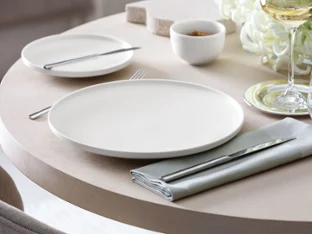 | Porcelain | ||||||||||||||
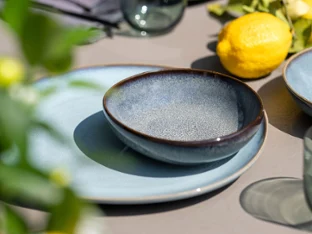 | Stoneware | ||||||||||||||
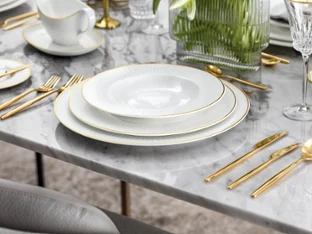 | Bone China |
Porcelain Durability:
Dense, Lightweight, and Built for Daily Use
Porcelain is fired at very high temperatures, which produces a dense, non-porous body. That density is what gives porcelain its durability; it resists chipping, scratching, and staining while remaining lightweight enough for everyday handling.
Because it’s non-porous, porcelain also resists absorbing odors, stains, and moisture, which is part of why it performs so well through repeated dishwasher and microwave use over time.